
API 5CT Seamless Tubing Pipe OCTG
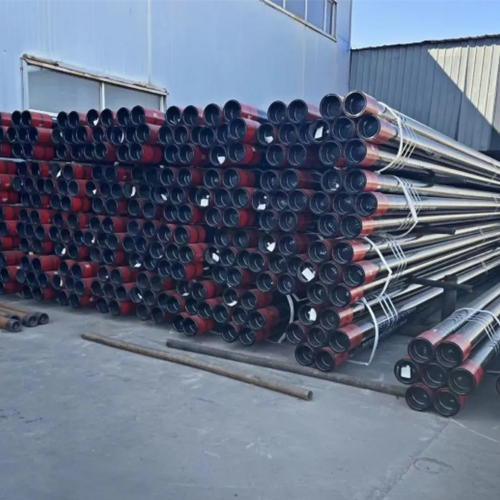
Features
- Seamless construction that holds internal pressure along the whole length of the string
- Thinner wall than casing, built to carry fluids rather than support the wellbore
- L80 9Cr and 13Cr options for wells with H2S or CO2 in the produced fluid
- Three connection styles, so the string can be matched to well depth and pressure
- Every length hydrostatically tested, drifted, and inspected before dispatch
- Custom lengths, coatings, and thread protection available
Specifications
| Parameter | Specification |
|---|---|
| Standard | API 5CT / ISO 11960 |
| Grades | H40, J55, N80, L80, C90, T95, P110 |
| Manufacturing Process | Seamless, hot rolled |
| Heat Treatment | Normalized, normalized and tempered, or quenched and tempered, per grade |
| Outside Diameter | 1.050″ to 4 1/2″ (26.7 to 114.3 mm) |
| Wall Thickness | 2.9 to 12.7 mm, per API 5CT weight table |
| Length | R1 (6.10 to 7.32 m), R2 (8.53 to 9.75 m), R3 (11.58 to 12.80 m) |
| End Connections | NU (non-upset), EU (external upset), IJ (integral joint) |
| Surface Finish | Black, varnished, painted, or galvanized |
| Testing | Hydrostatic, non-destructive examination, drift, tensile, hardness, and impact on request |
| Typical Use | Production tubing for oil and gas wells |
Grades and Mechanical Properties
| Grade | Yield Strength (MPa) | Tensile Strength min (MPa) | Typical Service |
|---|---|---|---|
| H40 | 276 to 552 | 414 | Shallow, low-pressure wells |
| J55 | 379 to 552 | 517 | Standard sweet service wells |
| N80 (Type 1 and Q) | 552 to 758 | 689 | Medium depth wells |
| L80 (Type 1, 9Cr, 13Cr) | 552 to 655 | 655 | Sour and CO2 corrosive service |
| C90 / T95 | 621 to 758 | 689 / 724 | High-strength sour service |
| P110 | 758 to 965 | 862 | Deep, high-pressure wells |
Size Chart
| Size (in) | Outside Diameter (mm) | Available Connections |
|---|---|---|
| 1.050″ | 26.7 | NU, EU |
| 1.315″ | 33.4 | NU, EU, IJ |
| 1.660″ | 42.2 | NU, EU, IJ |
| 1.900″ | 48.3 | NU, EU, IJ |
| 2 3/8″ | 60.3 | NU, EU |
| 2 7/8″ | 73.0 | NU, EU |
| 3 1/2″ | 88.9 | NU, EU |
| 4″ | 101.6 | NU, EU |
| 4 1/2″ | 114.3 | NU, EU |
Use Case
- Carrying oil, gas, and water from the reservoir to the surface
- Protecting the casing from corrosive fluids, heat, and erosion
- Injecting water, steam, or chemicals for enhanced oil recovery
- Running downhole tools and equipment
- Onshore and offshore production wells